

Applications Notes / Bulletins
Trokut Solutions caters to widest range of applications in the field of Scientific Research and Industry
Browse Photovoltaic Technical Bulletins
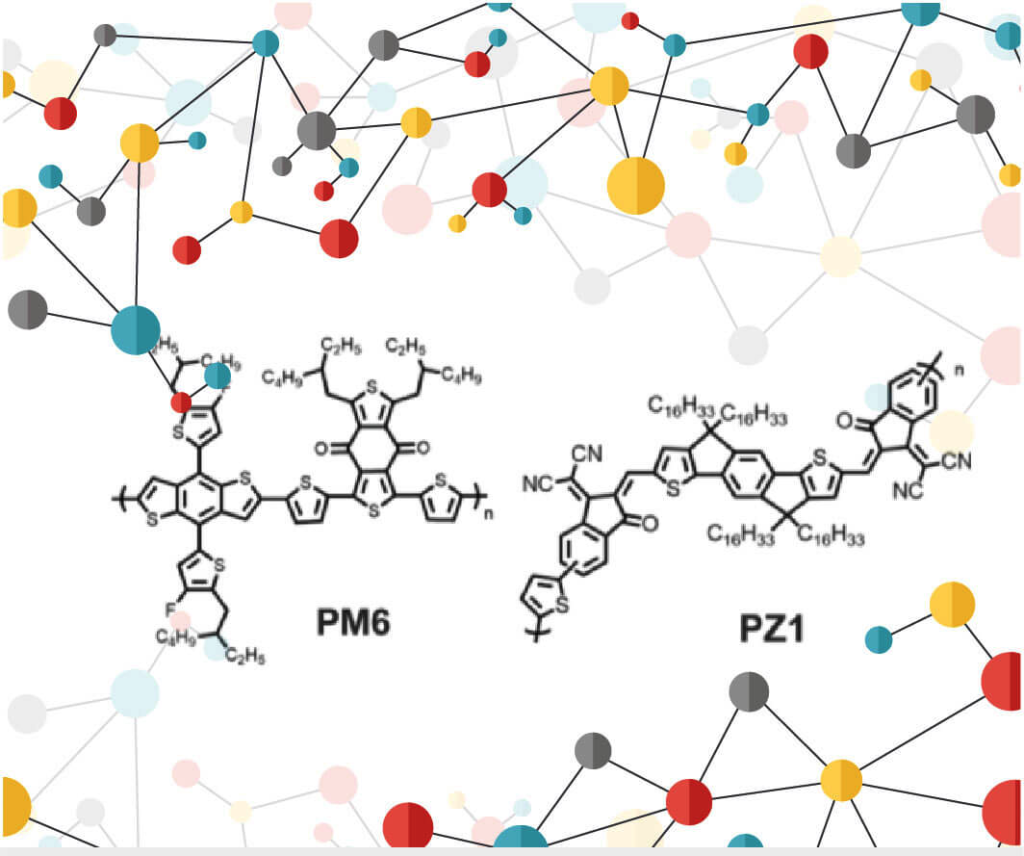
Materials scientists from the Soochow University in China have fabricated all-polymer solar cells (all-PSCs) with 11.2% high efficiency.
Among various strategies to develop the high efficiency conjugated donor polymers, the substitution of fluorine atoms on the conjugated polymer backbone has attracted considerable attention recently, due to the simultaneous lowering of the highest occupied molecular orbital (HOMO) without sacrificing the bandgap, enhanced molecular ordering, high extinction coefficient, and the ability to tune the blend morphology to reduce the charge carrier recombination..
Single junction all-polymer solar cells with high efficiency of 11.2%
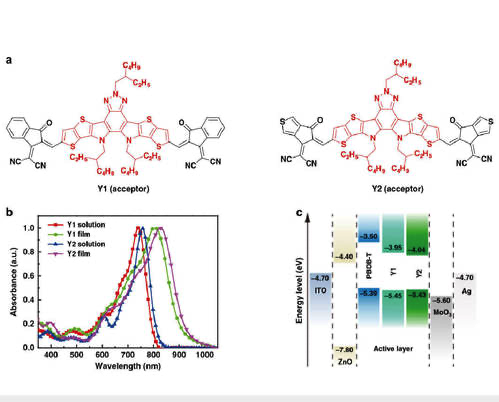
In an advance that makes more efficient in organic photovoltaics (OPVs), University of Central South researchers, Prof. Yingping Zou have developed non-fullerene acceptor organic photovoltaics (NFA-OPV) devices that can achieve 15.7% efficiency..
Before that research came out, Prof. Yingping Zou cooperated with Prof. Yang Yang from UCLA, and Prof. Feng Gao from Linköping University reported a successful strategy to tune the optoelectronic properties by introducing electron-deficient-core-based fused structure into non-fullerene acceptors.
New Strategy for fullerene-free OPVs: Achieving low voltage loss and high photocurrent
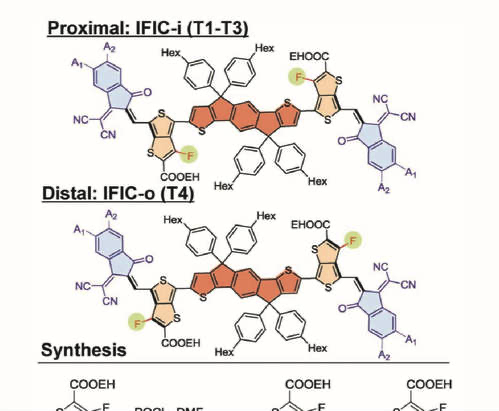
Scientists at the Department of Polymer Science and Engineering, Zhejiang University have presented a family of near-infrared nonfullerene acceptors (NIR NFA, T1-T4) with fluorinated regioisomeric A–Aπ–D–Aπ–A backbones for constructing efficient single-junction and tandem PSCs with photon response up to 1000 nm.
With the rapid development of new electroactive molecules, the polymer solar cells has experienced fast breakthrough over the past few years. The promising virtue for PSCs is their functional tunabilities stemming from the chemical versatility of organic semiconductors which allows their production in large quantities at relatively low price.
For instance, the recent development of near-infrared (NIR) organics (bandgap, Eg < 1.4 eV) enables PSCs with strong NIR photon responsiveness and visible-range transparency, which are promising for constructing tandem and semitransparent PSCs.
Recent progress in Polymer Solar Cell: Breakthrough Efficiency of 14.64%
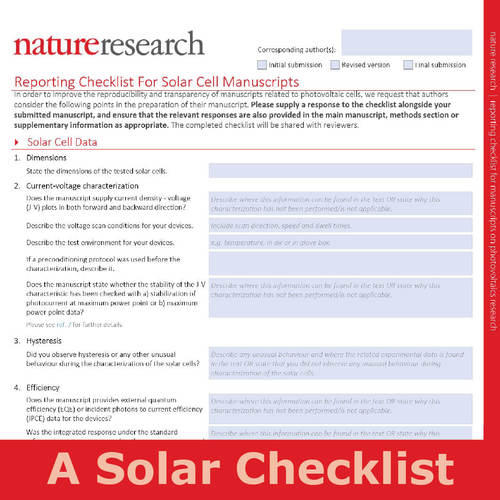
Nature Publishing Group highly recommends authors of papers related to solar-cell research complete this solar checklist of submitted information to aid the reproducibility and transparency of results.
Following discussion with experts in the photovoltaic community and the publication of several articles on the topic of mischaracterization of solar cell efficiency, Nature Photonics (along with other physical science research journals published by Nature Publishing Group) is introducing a checklist for papers submitted on the topic.
Keywords :
- Solar Characterization .
- Natue Check list for paper submission.